
Multi-orbit Satellite Channel Emulator
Fully software-defined emulator capable of reproducing real-world propagation effects such as delay, Doppler, fading, and interference with precision comparable to high-end systems but at a fraction of the cost.
Contact Us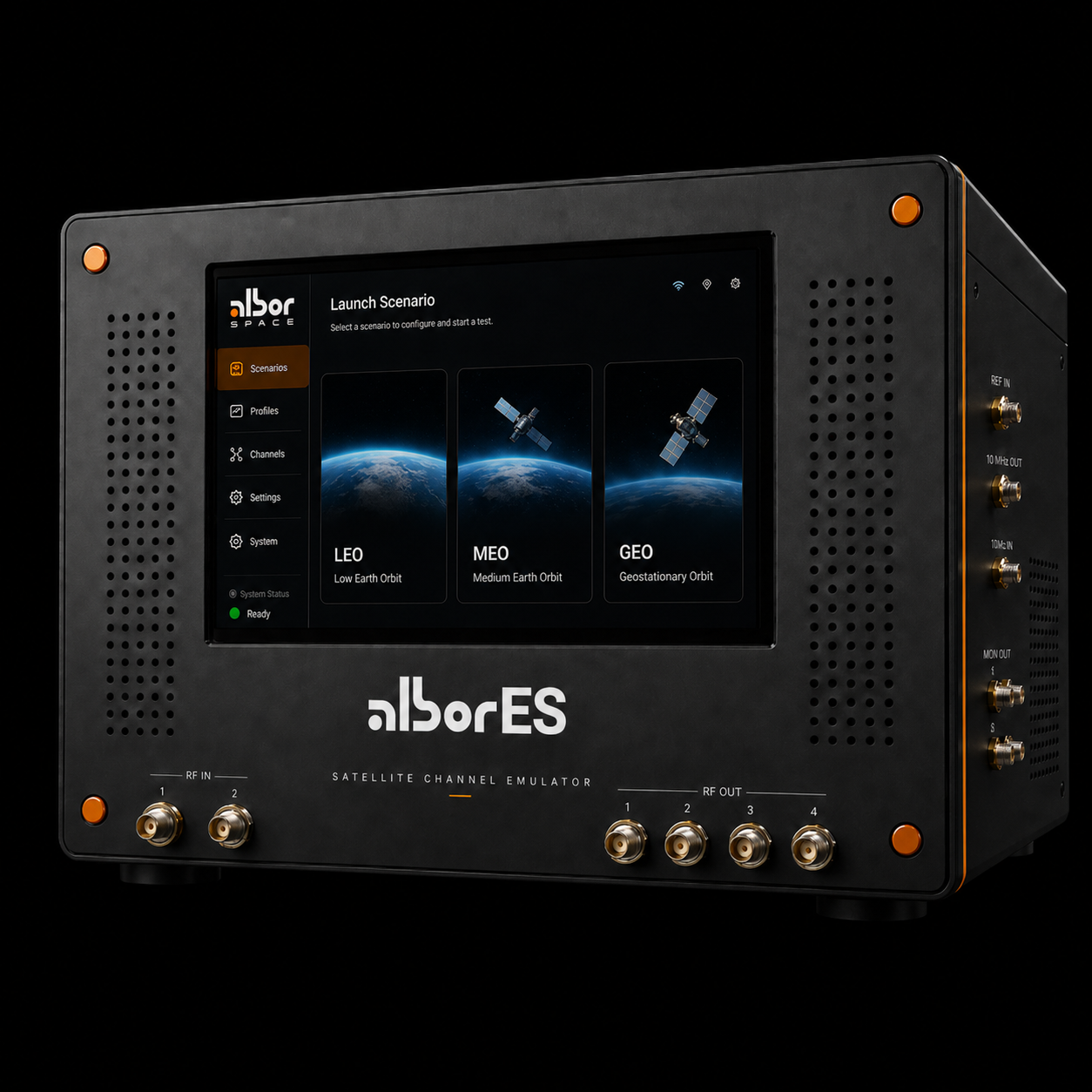
Key Capabilities
A software-first approach that delivers deterministic performance and flexibility for all orbital regimes.
Software-First Architecture
Replaces FPGA-based architectures with a signal-processing engine on general-purpose processors.
- Rapid scenario setup with reusable templates
- Deterministic performance across multi-terminal topologies
- Visual analytics for Doppler, fading, and QoS metrics
Deterministic Low Latency
Interfaces with SDRs to ensure minimal latency suitable for LEO, MEO, and GEO regimes.
- Rapid scenario setup with reusable templates
- Deterministic performance across multi-terminal topologies
- Visual analytics for Doppler, fading, and QoS metrics
Standards Aligned
Fully aligned with ITU and 3GPP NTN specifications (Releases 17, 18, 19).
- Rapid scenario setup with reusable templates
- Deterministic performance across multi-terminal topologies
- Visual analytics for Doppler, fading, and QoS metrics
Technical Specifications
Engineered for validation and pre-launch testing.
Core Features
- Real-time channel emulation
- Multi-orbit support (LEO/MEO/GEO)
- 3GPP NTN Release 17/18/19 compliance
- High-fidelity Doppler & Fading models
Integration
- REST/gRPC APIs
- Python SDK
- CI/CD integration
- SDR interface compatibility